Saturday, January 27, 2007

Jogless stripes--a new way

includes a how-to
click picture
Knotingale asks "can you explain the 'jogless' join method for stripes knit in the round? I can't understand the instructions I've found thus far."

As we say here in Wisconsin, "yup, you bet!" Here's the short answer.

JOGLESS STRIPE HOW-TO
(a new way)
  • On color change rounds, change colors by knitting the first stitch of the new color as you usually would. Then, knit the rest of the stitches to the end of the round.
  • On the next round, slip the first stitch of the new color, then knit the rest of the stitches.
  • On every following round, knit every stitch as usual
Keep doing this over and over again. That's it. That's really all there is to it. Well--nearly all. You still face the issue of--

STACKING the COLOR CHANGES

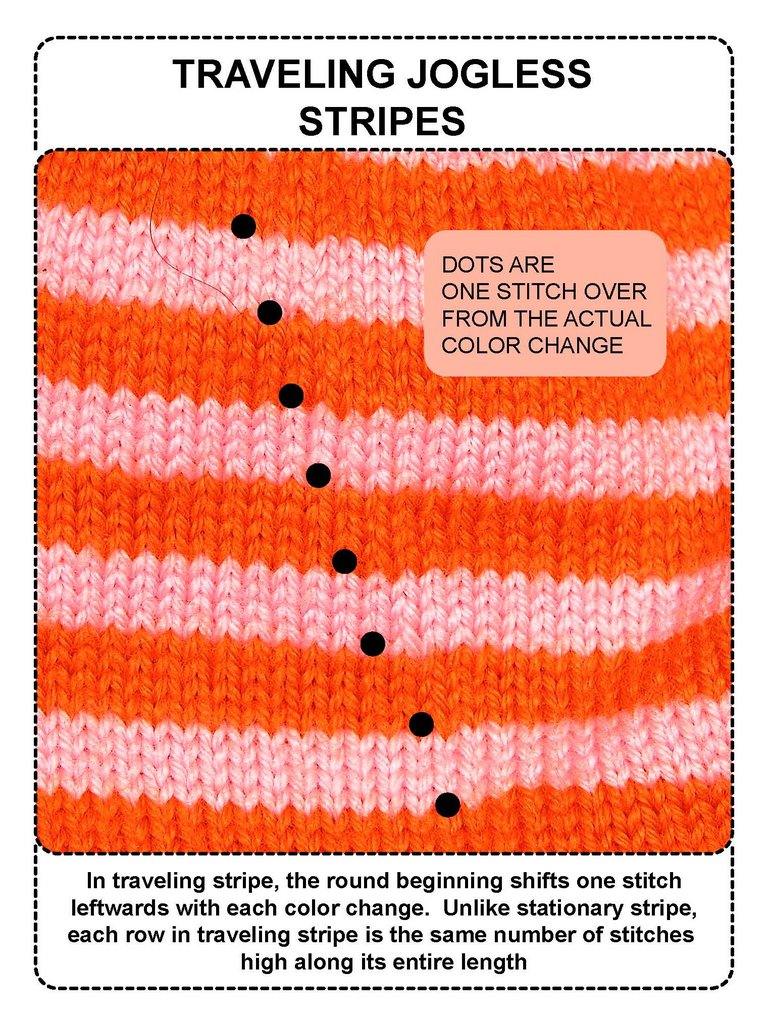
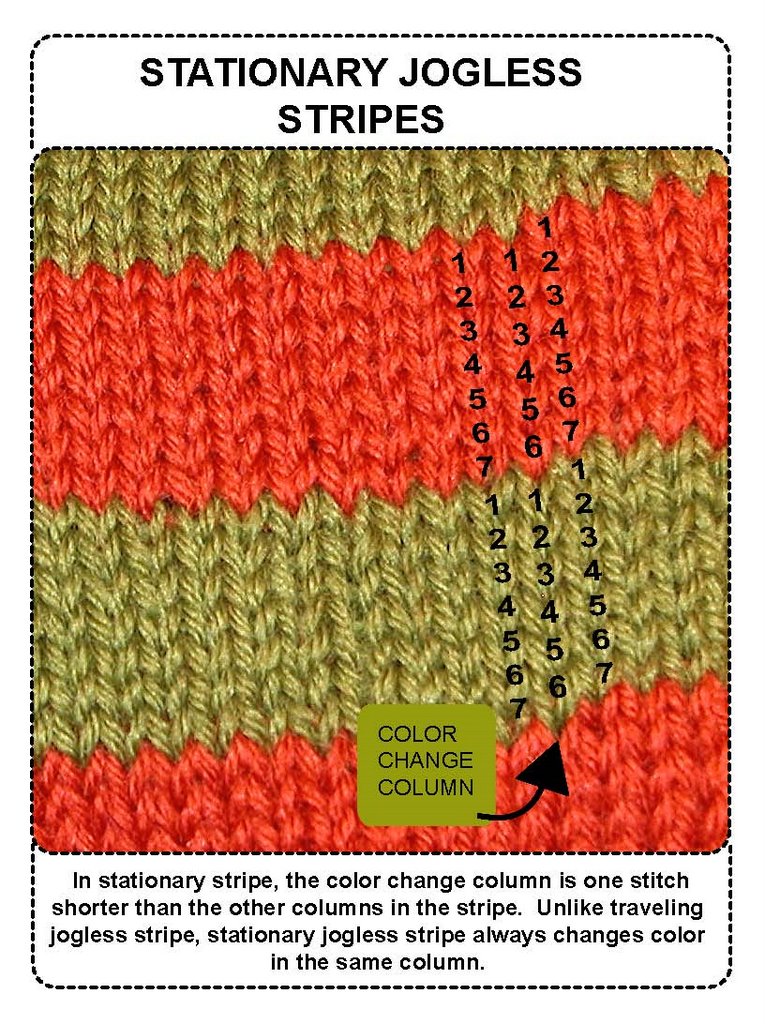
The only thing at all complicated in jogless striping is how you choose to stack the color changes. If you choose to let the beginning of the round travel one stitch to the left with each color change (this WILL make sense as soon as you try jogless stripes with needles) then every part of every row will be the same height and have the same number of stitches. Such jogless stripes are called "traveling stripes." If you choose to hold the beginning of the round in the same place, then at one spot on every stripe, there will be one fewer stitches. Such jogless stripes are called "stationary stripes."

Here it is, one more time, slower, with complete step-by step directions and more photos.

TRAVELING JOGLESS STRIPES
  1. On the round BEFORE you intend to change colors, insert a stitch marker at the place you intend to change colors.
  2. On the color change round--slip the marker, then change colors by simply starting to knit with the new color.
  3. On the following round, when you come to the marker, slip it. Then, slip the first stitch of the new color from the left needle to the right needle WITHOUT KNITTING IT (and without twisting it--this is called "slipping purlwise"). Knit all the rest of the stitches of the round.
  4. Knit as many rounds as you desire for the stripe, knitting every stitch.
  5. One the round BEFORE your NEXT color change, shift the marker over one stitch to the left.
  6. Make more stripes by repeating steps 2 though 5.
These stripes are called "traveling jogless stripes."
  • ADVANTAGE: Every part of every round is the same height.
  • DISADVANTAGE: The round beginning "travels" one stitch leftward with every color change.
click picture
STATIONARY JOGLESS STRIPES
  1. On the round BEFORE you intend to change colors, insert a stitch marker at the place you intend to change colors.
  2. When you come to a color change round, slip the marker, then change colors by simply starting to knit with the new color.
  3. On the following round, when you come to the marker, slip it. Then, slip the first stitch of the new color from the left needle to the right needle WITHOUT KNITTING IT (and without twisting it--this is called "slipping purlwise"). Knit the rest of the stitches of the round.
  4. Knit as many rounds as you desire for the stripe, knitting every stitch.
  5. Make more stripes by repeating steps 2 through 4.
These stripes are called "stationary jogless stripes."
  • ADVANTAGE: the color change remains in the same place.
  • DISADVANTAGE: at one part of each round, that round will dip one stitch lower.
click picture
WHICH TO CHOOSE?

With stationary stripes, each stripe dips one stitch lower at the color change. With thin stripes, and/or in thin wool, you'd soon have substantially fewer stitches along this column, so the fabric might start to "pull" along that column of stitches. However, with thick wool (5 st/in or fewer) and/or thicker stripes, this isn't an issue because the knitting stretches enough to solve the problem. Therefore, stationary stripes are best for thick wool and/or thick stripes.

With traveling stripes, a faint spiral pattern will develop along the diagonal of the color change, so be careful not to pull your yarn too tight, especially if you are carrying the yarn behind from stripe to stripe. This spiral pattern is more obvious in heavy fabrics and less obvious in thinner fabrics, so the traveling stripes are better for thinner stripes and/or thinner wool.

If you have thin stripes in thick wool, or thick stripes in thin wool, you'll have to make up your own mind.

JOGLESS STRIPES AND GARMENT SHAPING

If you choose stationary stripes, you have no problem you wouldn't have with regular (non-jogless) stripes--you begin the garment shaping as directed in the pattern. If, however, you choose to let the round beginning shift by one stitch with each stripe--what will happen when you come to shape the garment?

Suppose your directions require that, "at the beginning of the next round," you must increase (or decrease) to shape the garment. If you've been using traveling stripes, where the heck IS the beginning of the round? Is it where the COLOR beginning of the round is, or is it where the cast-on ACTUAL beginning of the round is?

Long answer short: if you've used the 3-in-1 TECHjoin to start your circular knitting, you won't really be able to tell where the cast-on beginning of the garment is. This frees you to use the COLOR beginning as the beginning of the round. You start your shaping opposite the last color change (double-headed arrow photo below). When you start the shaping, you switch gears. In other words, once shaping begins, you hide the color change IN the shaping (the right part of the photo below). This keeps the color beginning of the round from wandering further and avoids complications.
click picture
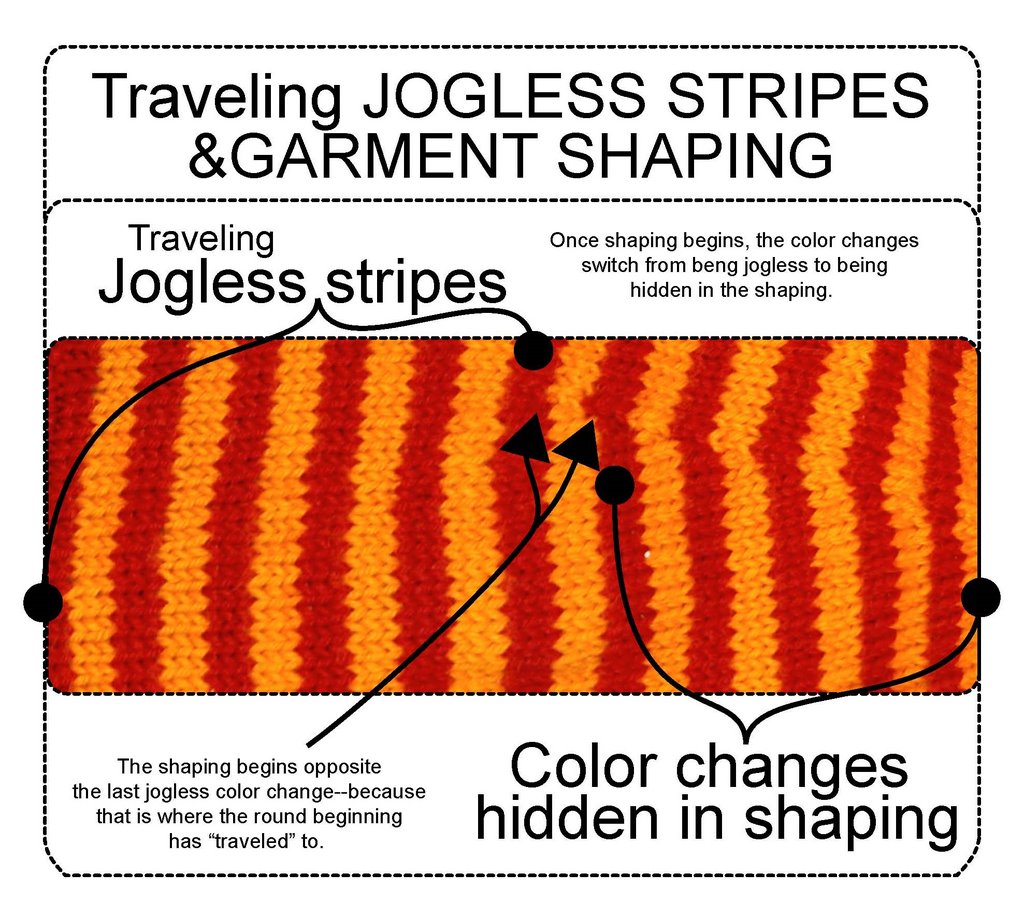
Are you wondering how the spiral shift of traveling stripes will affect the shape of the finished garment? Will the one part of the garment be longer than another? The short answer is "no problem." Many knitted garments face this issue--to match shaping, the left front and the right front of a cardigan are almost always off by one row. The same thing with shoulder shaping--that too is almost always off by one row between the left and the right shoulders. Even a circular-knitted sock is one row off between the left side and the right side of the heel tab, or on either side of a short row heel. Knitting stretches, and a spiraling round beginning will not cause any greater problem than do any of these.

WHY ARE OTHER INSTRUCTIONS SO COMPLICATED?

In some other instructions, the pattern writer seeks STATIONARY color changes (the color change should stay in the same place) AND the same number of stitches in every part of every round. The only way to accomplish this is by somehow inserting an extra stitch in the same column as the color change, which can get messy pretty fast.

In other instructions, the jog is evened out--not by slipping the first stitch of the new color as set forth in this post--but by slipping some other stitch or part of a stitch already knitted (typically, a stitch in the row below). The complication isn't really one of execution--it is one of explanation. In other words, the complication arises from trying to explain which stitch or which part of which stitch from the row below should be slipped "up" onto the left needle, how that should be done, and what to do with it once it's there.


CONCLUSION

One thing is for sure: regardless of how you choose to stack your color changes, whether with traveling jogless stripes or stationary jogless stripes, your result has got to be better than regular (jogging) stripes--see photo below.
click picture


--TECHknitter

54 Comments:

Anonymous Cyndi said...

Great post! Love the last one on joining in the round too. Keep up the excellent tutorials - I always look forward to your posts.

January 28, 2007 6:50 PM  
Blogger Trish - My Merino Mantra said...

Welcome back! I hope your enjoyed your trip! I am afraid that the last stripes I did jogged all over the place. At least, it seemed like that to me. Thanks so much for the explanation!

January 28, 2007 8:24 PM  
Anonymous Knotingale said...

You did it! 10-q very much.

January 28, 2007 10:21 PM  
Anonymous Anonymous said...

Wow! This looks like a great technique. I can't wait to try it. Also the photos are really colorful and cheerful. Thanks so much Techknitter!

January 30, 2007 10:44 PM  
Anonymous Caren said...

You are truly a Techknitting goddess! I've been using your "stationary jogless stripes" technique on my current project (Dale of Norway "Fana" pullover for my 3 yr old), and it's FABULOUS! My stripes look great, with nary a jog in sight, and no diagonal beginning-of-round movement. Thank you thank you thank you. You have secured "most favored status" on my blog-reading list from now on.

February 9, 2007 8:00 PM  
Blogger --TECHknitter said...

--You're very welcome. Send a picture when you're done, OK?

February 10, 2007 9:01 PM  
Blogger Lien said...

I've been either avoiding striping, or doing striped things by knitting back and forth, because I've never been happy with other jogless striping methods.

I think I can stop doing that now because this is the simplest explanation for a jogless stripe I've ever seen. Brilliant!

May 11, 2007 8:53 AM  
Blogger Andy's Crafts said...

Excellent exposition of the nomad stitch. Thanks a lot.

August 13, 2007 1:48 PM  
Anonymous Sue in Pardeeville said...

Thanks for the extremely lucid explanations. I'm knitting a bag to felt (using two-color stranding for the first time), and your excellent technique has made the crooked stripes straight.

One section of my bag has diagonal cross-hatching (grass green on a pumpkin background), and I find that even a diagonal stripe will jog unbecomingly at the beginning of every round. Slipping the first stitch of each round eliminated the jog but created a too-obvious solid green diagonal line. However, slipping 3 stitches rather than 1 helped to keep the cross-hatching more even in appearance. Are there any other ways around this problem?

Thanks again for all the great info on your site. Happy knitting through our long Wisconsin winter!

November 19, 2007 11:40 PM  
Anonymous handknit said...

Thank you very much for the most clear explanation of this technique. I had not planned on doing anything with stripes in the immediate future, but I may change my mind!

I discovered your site a few weeks ago and am picking my way through your back posts. I truly appreciate the way you present ideas. I immediately adopted your best method of left-slanting decrease (Oct or Nov '07)and am in awe of how it looks. I've shown it off to everyone, including my 16 year old boy, who was ... polite.

November 22, 2007 3:08 PM  
Anonymous susanp_y said...

Thank you so much for this technique. It is wonderful.

January 17, 2008 11:27 PM  
Blogger the Lady said...

Super-great tutorial! I'm bookmarking this.

February 15, 2008 3:59 PM  
Anonymous Laura said...

The slipped stitch solution is brilliant -- more discreet than the usual jogless jog technique IMO. Thanks for another terrific post.

March 5, 2008 1:31 PM  
Blogger HPNY Knits said...

thanks you!

June 23, 2008 3:50 PM  
Anonymous Gabrielle said...

Hi there =)
Wonderful tutorials thankyou!
I was wondering if there is any way to make SINGLE ROW STRIPES without a jog? Say, a stripe (one row) of blue, then a stripe (one row) of brown ... and so on?
Thanks a bunch,
Gabrielle

June 26, 2008 12:47 PM  
Blogger --TECHknitter said...

Hi Gabrielle--You CAN make one row stripes, but not by this method. The one-row method is actually SPIRAL. It is very well described by Montse Stanley in her famous "Knitter's handbook. http://www.amazon.com/
Knitters-Handbook-Comprehensive-
Principles-Handknitting/dp/0762102489
(To use the link, you'll have to cut and paste to your browser, AND remember to remove the spaces.)

Also, a very popular blogger, GRUMPERINA recently had a series on spiral stripes on her blog
http://www.grumperina.com/knitblog/

--good luck, TK

June 28, 2008 9:28 AM  
Blogger Nancy said...

Very helpful, thank you! Great explanation, and illustrations.

I just found your blog today, and I'll certainly be back! I also love the technical aspects of knitting. Are you, by chance, a mathematician or scientist? I'm finding that a lot of knitters are, especially the technique-oriented ones.

Nancy in Oregon

October 17, 2008 12:05 PM  
Anonymous Anonymous said...

I have just discovered this blog today and it makes me smile like this. :D

Thanks for the tutorial!

November 14, 2008 2:30 PM  
Blogger Carol Schatz said...

I'm not sure I am ever going to knit stripes!

December 9, 2008 6:57 PM  
Blogger Daniel said...

Thank you... :-)

December 30, 2008 4:10 AM  
Blogger Laura said...

This is great! I am a beginning knitter and the jogless stripes worked beautifully. But I am making a hat and am worried that when I start to knit stitches together this will all get messed up? How do I ensure that the top of the hat looks as good as the bottom?

January 7, 2009 10:44 AM  
Anonymous website design New York City said...

nice post

January 26, 2009 11:42 PM  
Blogger --TECHknitter said...

Hi Laura: Sorry to have taken so long to respond to you. As set forth in the bottom part of the post, once you get to the decreasing for the top of the hat, you switch yarn at the decrease, and this hides the jog. If you examine the photo illustration of the striped hat (Second to last illustration) you will see that the jogless joins are replaced by joins in the decrease line, and that the joins in the decrease line really don't show.

Best, TK

February 4, 2009 8:10 PM  
Blogger Marie Wesley said...

Ok. You win for my new favorite person for the rest of the day. I am bookmarking this post for future reference! Good job.

March 19, 2009 9:38 PM  
Blogger Regina said...

When I "change colors by simply starting to knit with the new color" I end up with a hole there. Any ideas?

May 25, 2009 12:50 AM  
Blogger --TECHknitter said...

Hi Regina
You will get a hole the first time you add any color, but after that, you will not, because the yarn traveling up the inside of the garment crosses and closes the hole. For that first hole, it gets closed up when the end is worked in.

Oh--you will also get a hole on the last row of a color, and that hole, too, is eliminated by working in the end!

May 27, 2009 9:38 AM  
Blogger Cheryl said...

Thank you a million times!!!!!!!!

June 2, 2009 3:25 PM  
Blogger Monika Nowaczyk said...

This is so great! Thank you for the time and effort to share this with everyone!

July 18, 2009 9:14 AM  
Anonymous Anonymous said...

I'm confused about one thing: when you say "slip the first st. of the new color", you haven't knit with it yet, so how can you slip it? Do you mean "slip the next stitch" or am I totally missing the boat on this? Thank you so much for posting this! I've been knitting for over 40 years & now I should be able to finally make a nice-looking stripe. --Fay in FL (currently in Wisconsin!)

July 19, 2009 11:39 AM  
Blogger --TECHknitter said...

Hi Fay--the slipping occurs when you come around AGAIN. In other words, you simply join in the new color and knit normally for the first round, then in the SECOND round, you slip the first stitch of the new color. This draws the first stitch of the new color into a sort of half-way position between the two rounds, and thus eliminates the jog. Thanks for writing. TK

July 19, 2009 9:37 PM  
Anonymous Anonymous said...

Light bulbs coming on -- thank you!! It makes perfect sense now. I love all your tips & explanations -- thank you so much for sharing.

~Fay in FL

July 19, 2009 10:35 PM  
OpenID nevermelts said...

Not sure how to eliminate the hole - I 'm making a child's hat so I can't leave the colors intact and let them hang out inside the hat. I've been tying knots, which closes up the hole and pulls the jog even closer. I'm happy with this so far since it looks really good, but is the knot going to come undone? I've never tied knots and I'm a relatively new knitter so I don't know. I had started by weaving in but it seems like it could come loose too easily since it's for a child and will probably be beat up and stretched out often.

July 29, 2009 6:13 PM  
Blogger --TECHknitter said...

Hi Nevermelts: there will be no hole if you carry the yarn up the inside--which is really the very easiest way to make stripes!

July 29, 2009 9:18 PM  
Blogger Meg said...

Ok, unfortunately I'm stuck on the first sentence *blush* "change colors by knitting the first stitch of the new color as you usually would" how would I usually do this knitting in the round? Do I just hold a tail off the back and go for it or is there a technique to it? I saw your post on how to add in a new ball of the same color, but how do you add in a new ball of a different color??

Thanks!!

August 19, 2009 1:11 PM  
Blogger --TECHknitter said...

Hi Meg--sorry to have been obscure! What I SHOULD have said was: "change colors by simply dropping the old color, and working the next stitch with the yarn of the new color." Hope this helps! --TK

August 20, 2009 3:37 PM  
Blogger Bobbi said...

Thank you so much! I wanna post a link to your blog in my blog entry for today. Is that ok?

Bobbi

September 21, 2009 9:09 AM  
Blogger --TECHknitter said...

Hi Bobbi--plese feel free to add a link, and thanks for writing. --TK

September 21, 2009 10:06 AM  
Blogger savvy said...

Your instructions are wonderful. After just a couple of practices, I've "mastered" jogless stripes and now can confidently make striped garment without fear of the knitting police taking all my yarn away.

September 28, 2009 2:53 PM  
Anonymous Anonymous said...

I was so excited to see your post and try out some jogless stripes. Thank you.

Somehow, though, while your instructions seem to be perfectly clear, I am still finding that my stripes are jogging and wonder if it might have been better if I had just left them alone. I am a somewhat experienced knitter who seldom has trouble figuring these things out, so the fact that I can't seem to make this work is boggling my mind.

The pattern I am using works two rows in each color. Could that be the issue? Would it be less likely to show if I had more rows in each color? Maybe I'm pulling too tightly on the yarn when knitting into the second stitch of the second new color row (i.e. the first stitch after the slipped stitch)???

I know it's hard to offer insight without seeing my project. I just was so excited to see your clear, simple instructions, and now I'm a little frustrated that it hasn't worked out for me. I'm such a perfectionist, and this is driving me crazy! I wish I could figure this one out.

-Sarah

*Going back to my little project and hoping I don't get so flustered that I end up ripping!*

October 27, 2009 8:37 PM  
Blogger --TECHknitter said...

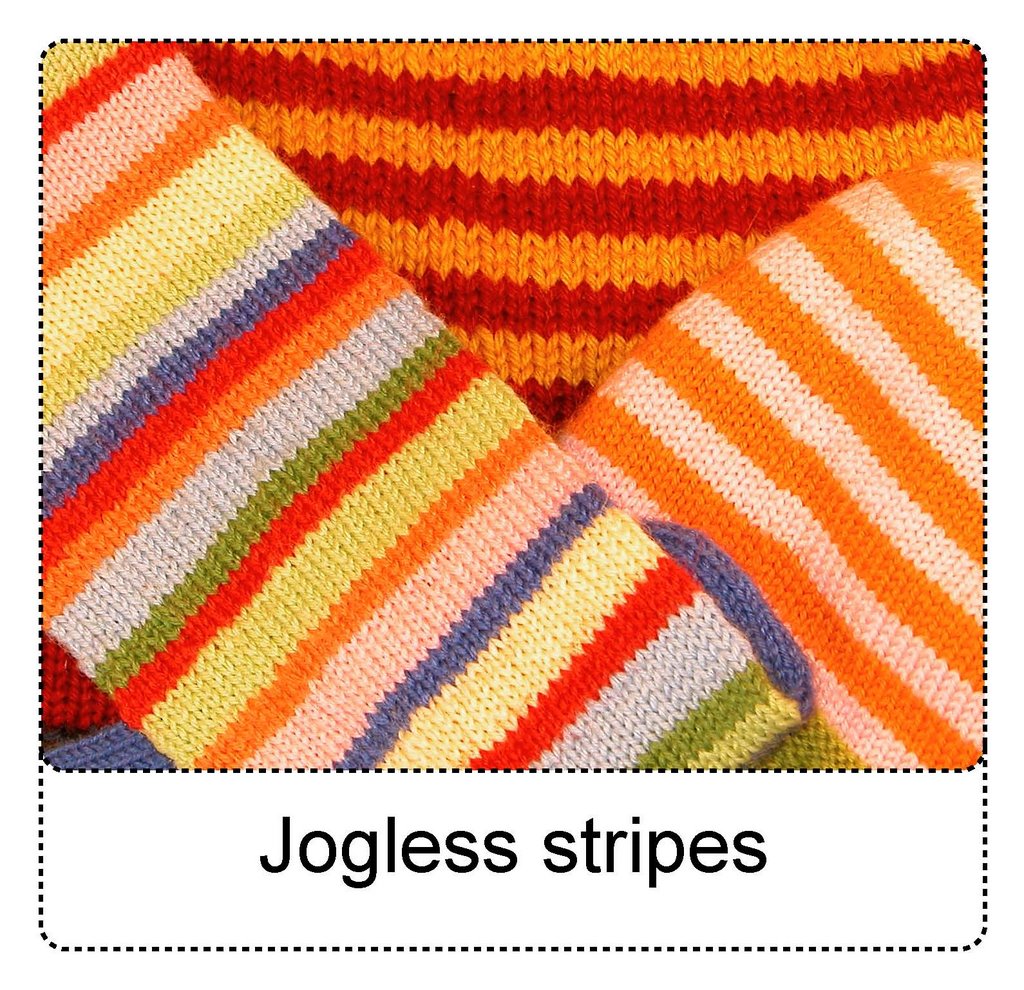
Hi Sarah--two-row stripes are a challenge, for sure. Is it at all possible to turn your stripes into 3 row stripes? The sock in the opening photo has quite a few 3-row stripes, as does the red-and-yellow striped hat-and those work pretty well, as you can see for yourself (the "jogless jogs" of both garments are facing the camera).

If two row stripes are a must-have, can you get hold of an Interweave Knits summer 2009? Maybe from the library? There is an article in that issue by yours truly about "barberpole stripes" and these can be adapted for two row stripes, as that article explains--that trick takes a bit of fooling with, but makes perfect jogless stripes 1 or even 2 rows high.

(next summer, the copyright of that article reverts to me, and I can publish it on my blog, but not until then :-( so you will have to track down the magazine if you want to read about it in the meanwhile...)

--TK

October 27, 2009 10:09 PM  
Anonymous Anonymous said...

Thank you again. I feel better after reading your response. I will look and see which IK issue I have; I know I have either summer or fall. Maybe I can pick up a copy of the summer issue if I don't have it. Otherwise, my next version of the little toy I'm making will definitely have three row stripes!

-Sarah

October 28, 2009 8:53 AM  
Blogger Marilyn said...

Wow! These directions are great! Thanks so much for sharing your knowledge. I can't wait to get going on my stripes now!

October 29, 2009 8:59 PM  
Anonymous Anonymous said...

Thanks very much for this technique. Question... for step #5 "on the round before your next color change, shift the marker over one stitch to the left," what if you have just made your final color change? Do you still at some point have to shift the marker over again to keep things in line, or do you skip this step and just keep knitting as in step #4 until you're finished? (I'm making a hat.) Thanks!

October 31, 2009 10:48 AM  
Blogger --TECHknitter said...

Hi Anonymous-- the moving of the marker is just to let you know where the next color change is to start--if you've finished the last stripe (including the color change AFTER the stripe) then you can get rid of the marker--it's encoding information you no longer need.

--TK

October 31, 2009 3:37 PM  
Anonymous Anonymous said...

Thanks very much! My stripes are beauteous!

November 1, 2009 7:27 AM  
Blogger Maritima said...

Would this work for changing from ribbing to stockinette? For example: when you are knitting a topdown sweater and switch from the neck ribbing to stockinette, or from stockinette to bottom ribbing.

November 2, 2009 5:35 PM  
Blogger --TECHknitter said...

Hi Maritima--I assume you mean that you are also changing the color, not just the texture? If yes, then have a look at this post


http://techknitting.blogspot.com/2008/03/jogless-ribbing-with-trick-to-work-your.html


If you just want a neat way to transition between ribbing and stockinette, have a look at this post--

http://techknitting.blogspot.com/2007/03/where-ribbing-ends-improving-transition.html

If you mean something else, write again, OK?
--TK

November 2, 2009 6:34 PM  
Anonymous Anonymous said...

Hi TECHknitter! I'm making a hat on circulars that involves only a few color changes. One of the stripes is only a single round sandwiched in between 3 rounds of another color on the top and bottom. The rest of the hat is large sections (can't really call them stripes) of color, for which I will use your jogless travelling stripes method, but how do you suggest I handle the color change for that one single round? (Barberpole or spiral method doesn't really apply to this situation since it's not a series of multi-colored, single stripes - correct?) Thanks very much for any pearls of wisdom...

Debbie

November 14, 2009 12:50 PM  
Blogger TECHknitter said...

Hi Debbie: Thanks for writing. You are right--the jogless method doesn't really work very well for less than 3 rows (rounds) high, and the barberpole has no applicability in your situation. So, for a single round in the middle of a work, you are forced to fudge. Basically, work the single round leaving a long tail at one end, and, at the end when you're finishing, thread the tail onto your sewing needle and embroider a sort of half-stitch to hide the jog. ...That's all I got!

--TK

November 14, 2009 5:02 PM  
Anonymous Anonymous said...

Thanks TK - I will give that a whirl! Debbie

November 15, 2009 12:17 PM  
Blogger TECHknitter said...

Hello to the person who posted a comment asking whther this method would work for garter stitch. For some reason, after the comment was punched through for posting, the entire comment disappeared. Evidently, the gremlins in my computer ate it!

At any rate, as far as I know, there is no real way to avoid the seam in garter stitch knit in the round. However, one of these days, I will cast on and see whether anything comes to me. In the meanwhile, does anyone else have any insight into this?

--TK

November 23, 2009 11:47 AM  
Blogger aknottyknitter said...

I just discovered your blog and this method of working with stripes! Wow what a great technique .... I'm using it as I write .... so simple and looks terrific on the hat I'm knitting for Christmas ..... when all of my knitting projects for Christmas are done .... I will be back to check your previous posts!! Thank You!!!

November 23, 2009 11:15 PM  
Anonymous Anonymous said...

I was thrilled to find your instructions for jogless stripes as I wanted to make a striped beanie for my son. I was so excited and found my copy of interweave knits with your article and followed it very closely.... well I don't know what happened from your printed word to the tips of my needles but something is wrong!
I apparently know just enough knitting to be dangerous. Maybe what I don't understand is exactly how to weave in the ends from the stripes. Here's the striping I did supposedly using the stationary slip-stitch jogless stripes. I knit the ribbing then 10 rounds stockinette in the same color. 2 rounds of a contrast color. 4 rounds of 2nd contrast color. 2 rounds of 1st contrast color, finishing hat in main color. I have tried to weave in the ends a couple of times but it doesn't seem right. I have also asked others and been told to tie a knot weave in the ends and don't worry. I really am not worried I just want it right. Please help if you understand what I need to do other than retire my needles.

December 13, 2009 1:28 PM  
Blogger TECHknitter said...

Hi Anonymous--don't retire the needles. The problem you have is twofold. First, you're making very narrow stripes. Jogless stripes work better if they are at least 3 rounds high, and this is especially true of the stationary stripes. So, life will be a lot easier if you modify patterns to follow this rule.

Second, the stripes in the examples are all stripes where the other color is carried up the back. If you are cutting the yarn so as to work it in afterwards, then do this:

1. Do the jogless join,
2. Next, knot the ends of the two colors together LOOSELY.
3. At the end of the project, unknot the ends and cross them over each other before working them in. Crossing over can be plain (one laid over the other) or even better, they can be half-knotted together--like the little step you take before tying your shoes--half an overhand knot.
4. Once the ends are crossed, you can work them in in opposite directions by skimming them in (TECHknitting blog post of July 14, 2007) or by weaving them in (post of July 16, 2007) to the stripe of the same color.

The little step of crossing the ends prevents a hole from forming.

If the stripes aren't very high, like 6 rounds or less, consider not cutting the ends, but instead simply carrying the yarn not in use up the back of the garment. When you go to use a yarn which has been carried, be sure not to pull it so tight that it puckers.

Best of luck, and if you have further problems, write again, OK?

--TK

December 13, 2009 4:10 PM  

Post a Comment

<< Home